
Winners of the Fairest Datasets Award 2026
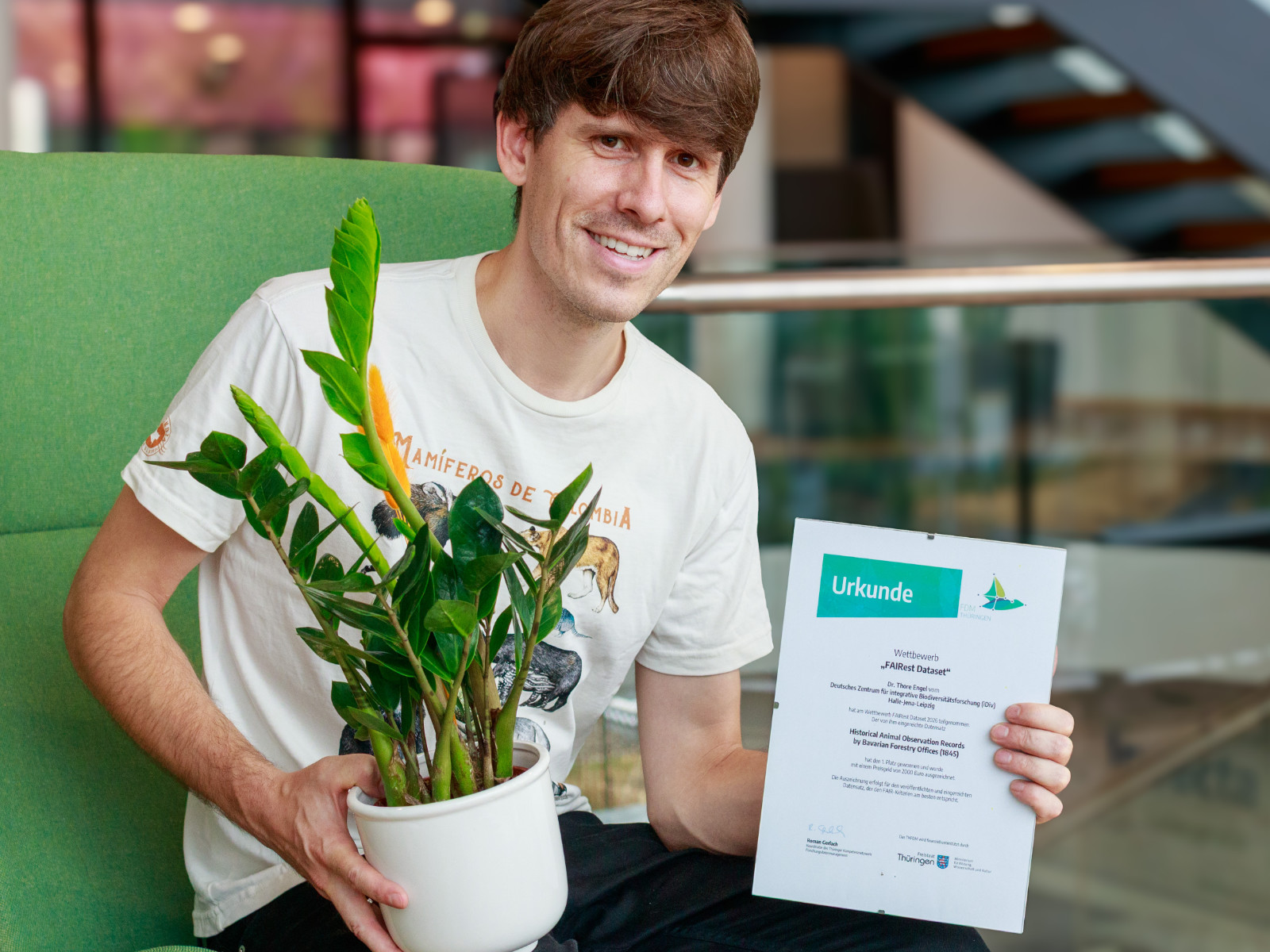
photo: ©Stefan Bernhardt / iDiv
Dr. Thore Engel of Friedrich-Schiller-Universität Jena, the Helmholtz-Zentrum für Umweltforschung – UFZ (Helmholtz Center for Environmental Research) and the Deutschen Zentrum für integrative Biodiversitätsforschung (German Center for Integrative Biodiversity Research) Halle-Jena-Leipzig accepts the award as the contact person for the dataset on behalf of all contributors.¹
After evaluating the submissions to the 2026 FAIRest Dataset Competition, we are pleased to announce the winner of the 2,000-euro prize.
The 2026 Thuringian FAIRest Dataset Award goes to the following dataset:
Rehbein, M., Escobari Vargas, A. B., Fischer, S., Güntsch, A., Haas, B., Matheisen, G., Perschl, T., Wieshuber, A., & Engel, T. (2024). Historical Animal Observation Records by Bavarian Forestry Offices (1845) (1.4) [Data set]. Zenodo. https://doi.org/10.5281/zenodo.14452998
The dataset best implements the FAIR criteria (Findable, Accessible, Interoperable, Reusable). During evaluation, we were particularly struck by the detailed and comprehensive documentation of the data, which is very important for replicability and reusability of any dataset. Congratulations to the winners!
Honorable Mentions
This year, we received a particularly large number of high-quality FAIRest dataset submissions. Since the margin between the winning dataset and the others was very narrow, we have decided to recognize the following five datasets (in alphabetical order) with an honorable mention:
- Engler, M., Stich, M., Baumer, C., & Bund, A. (2025). Supplement Data of Anolytes for All-Iron Redox-Flow Batteries [Data set]. In MDPI (Vol. 7, Number 4, pp. 571–583). Zenodo. https://doi.org/10.5281/zenodo.15730784
- Färber-Hesse, B., Lauströer, J., Andikfar, A., Stark, H., Anders, C., Unterhitzenberger, G., & Fischer, M. S. (2025). Der Rücken – Anschauliche Wissenschaft für die eigenverantwortliche Gesundheitsgestaltung: Videosammlung. https://doi.org/10.71758/refodat.53
- Mohr, L., Döbereiner, M., Andrich, C., Schwind, A., Schneider, C., & Thomä, R. (2026). Rhino: Bistatic Delay-Doppler Reference for Passive Radar Applications. https://doi.org/10.71758/refodat.72
- Schmidt, C., Lubojanski, A., Reinhardt, T., Bala Krishnan, R. K., Wesselak, V., & Nordhausen University of Applied Sciences. (2026). Input research data on the Thuringia energy system (ZO.RRO II) (1.0) [Data set]. Zenodo. https://doi.org/10.5281/zenodo.19202243
- Schumann, A., Lukas, F., Rieger, K., Gupta, Y., & Bär, K.-J. (2026). One-week test-retest stability of heart rate variability (Version 1) [Data set]. figshare. https://doi.org/10.6084/m9.figshare.26359453
The award-winning team
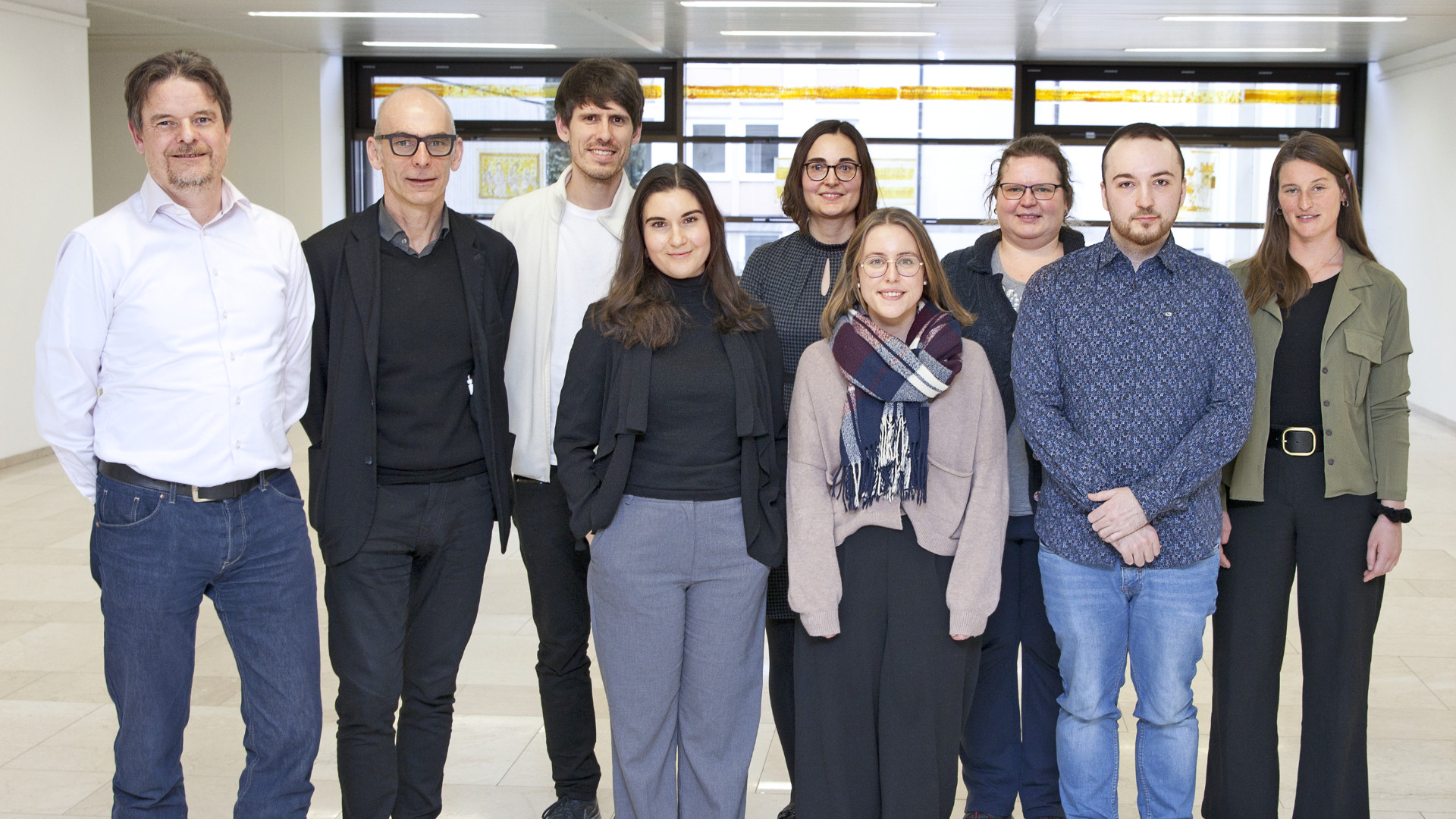
Information on the group photo: ©Elisabeth Miletic, Bayerisches Hauptstaatsarchiv
From right to left: Malte Rehbein, Alois Wieshuber, Thore Engel, Giada Matheisen, Lina Hörl (archive staff), Bettina Haas, Sarah Fischer-Zielke, Tobias Perschl, Ricarda Huter (A master's student at the University of Jena who reused the data in her thesis to analyze changes in biodiversity).
The dataset impressed with its consistent implementation of the FAIR principles and by combining approaches from different scientific disciplines for the cataloging of historical research data. In doing so, Findability, Accessibility, Interoperability, and Reusability are not merely treated as formal requirements but are brought to life. The perspectives of researchers from other disciplines are consistently taken into account. The use of standardized vocabularies and contextual information regarding the circumstances of creation and processing reduces barriers to reuse wherever possible.
Collaboration among researchers in biodiversity, the digital humanities, and Bavaria’s state archives made it possible to catalog wildlife observations from the mid-19th century and convert them into structured data. The published dataset is thus a valuable resource and benchmark for biodiversity research and an excellent example of interdisciplinary collaboration within the framework of NFDI4Biodiversity. The publication strategy complements the dataset on GBIF with additional information on Zenodo and a data paper in Nature Scientific Data. Keeping the end-user in mind, the data combines technical precision and disciplinary standards with a description of the data characteristics and their implications for re-use. The data are FAIR in the best sense of the term, and their presentation impressively addresses the challenging aspect of interoperability. The wide range of disciplines represented by the project participants and collaboration partners has been exceptionally enriching in this context2. Outreach beyond the scientific community takes place, among other channels, via the NFDI4Biodiversity blog, where the dataset was presented in detail.
The group itself values the visibility of the dataset. The ability to quantify data reuse through repository usage statistics is also cited as an argument for publishing the data. Added to this is the positive impact on the development and advancement of research approaches, which also extends to early-career researchers. The data is already being used for theses and subsequent research projects in the biodiversity sciences. The prize money is also planned to be used for this purpose. Thore Engel says, “With the prize money of 2,000 euros, we would fund a research assistant to help us mobilize biodiversity data in the Lebendigen Atlas der Natur Deutschlands (Living Atlas of Nature in Germany) and GBIF. This would enable us to uncover further exciting data treasures for biodiversity research (e.g., from the fields of citizen science and biodiversity monitoring).”
The FAIRest Dataset Award has been presented since 2020, making it the oldest FAIR award in the German scientific community. It is presented by the Thuringian Competence Network for Research Data Management to raise awareness among researchers about the handling of research data, to clarify the goals and requirements of good data management, and to improve the reuse of research data. The network includes the Thuringian universities in Erfurt, Ilmenau, Jena, and Weimar. It is funded by the four universities and the Thuringian Ministry of Education, Science, and Culture.
The TKFDM emphasizes the consistently high quality of this year’s award submissions. We are pleased that some of the submitters have already chosen the Thuringian Research Data Repository (REFODAT) to publish their data.
We would like to take this opportunity to once again thank all submitters and have prepared a small token of appreciation as a thank-you for participating in the competition.
You can find the winners from previous years, as well as information on how they used the prize money, here.
1) Malte Rehbein, Andrea Belen Escobari Vargas, Sarah Fischer, Anton Güntsch, Bettina Haas, Giada Matheisen, Tobias Perschl, Alois Wieshuber
2) The institutions involved were the Universität Passau, the Generaldirektion der Staatlichen Archive Bayerns, the Botanischer Garten und Botanische Museum Berlin, the Forschungsinstitut für Nutztierbiologie (FBN), the Friedrich-Schiller-Universität Jena, the Helmholtz-Zentrum für Umweltforschung – UFZ and the Deutsche Zentrum für integrative Biodiversitätsforschung Halle-Jena-Leipzig.